


Dylan Hoffman, Ph.D., is a relatively new addition to the faculty of Pacifica鈥檚 Jungian & Archetypal Studies program. I鈥檓 excited to learn more about his perspective and teaching.
Angela: You began your career at Pacifica in our M.A./Ph.D. program in Jungian & Archetypal Studies (DJA). What attracted you to Pacifica, and in particular the study of Archetypes?
Dylan: I grew up in a radical wing of the Christian Pentecostal movement, which in expectation for the return of Christ and the end of the world, rejected most kinds of involvement in society. Music, movies, dancing, television were considered demonic, contaminating influences that could seduce you away from remaining vigilant and pure for the Rapture. Everything I remember about my childhood and teen years was structured by this perspective. It got inside of me, affected me. I think I just always had a religious bent. Even though I grew up in abject fear of the God-image that dominated my early years, there was still something alive and numinous behind it all that stayed with me even as the Christian symbols and narrative ceased to contain and convey my experience of the Sacred.
Pacifica attracted me because the religious nature of the psyche is honored in its vision and curriculum. I was able to use my education in the Jungian and Archetypal Studies program to both learn about and experience the nature of the psyche and how it speaks within and without鈥攁nd track its communications culturally and in my own life. This has allowed me over time to embrace my soul鈥檚 natural religiosity and honor the sacred powers that I experienced as indigenous to my life and ancestry and vocation. The study of archetypes is central to this, because they are the soul鈥檚 innate and primordial dominants, the community of powers that comprise its totality, and our own, and the world鈥檚. Therefore, to come to terms with ourselves and our place in the community of the cosmos, we must come to terms with them.
Angela: What inspired you to return to Pacifica as a faculty member of the DJA program and what do you most enjoy about teaching here?
Dylan: I had entered the DJA program with the hope that I might teach Jungian and Archetypal Psychology someday after finished the program. Teaching the kind of content I was learning in DJA felt central to what I felt called to do with my life. And I expressed my interest in teaching throughout the program. So when an opportunity to return and teach opened up in DJA, I couldn鈥檛 say yes fast enough.
What I enjoy most about teaching is simply getting to share information, ideas, images, stories that convey a vision of the soul鈥攐f its imaginal and archetypal depths鈥攁nd of the world ensouled and enchanted, that I personally experience and espouse, which I think provides a way to live well with who we most deeply are, and with the world as the soul made tangible.
Angela: You鈥檝e said that depth psychology 鈥渋s only properly understood when the psyche is actually encountered and experienced as a communicating Other, made present in phenomenological expression鈥攊n the physiognomy of image, symbol, myth, dream, idea, fantasy, art, land, building, community, city.鈥� Is this because the psyche is something so mysterious to us that we have to translate it into terms we understand, using analogies to something external to us? And how does this inform the way you teach about depth psychology?
 Dylan: I do think the psyche is so mysterious that we need symbols鈥攂oth imaginal and material鈥攖o mediate our relationship with the unknown. But such symbols aren鈥檛 of our making, not things we construct for ourselves in an attempt to make sense of the psyche. That kind of attempt would be useless in terms of understanding the psyche. The psyche鈥檚 mystery is inviolable. We don鈥檛 learn anything about the psyche unless the psyche makes itself known鈥攁nd more often than not we avoid the psyche鈥檚 disclosures rather than seek them out. Fortunately for us, the psyche doesn鈥檛 let us get away with this with impunity. We nor the world are of our own making. We鈥檙e never other than or outside of psyche. We can no more avoid psyche than we can avoid breathing. We can try for a while, but then it starts to hurt, and then it starts to get deadly.
Psyche senses when we are suffocating, metabolizes the stale images and ideas that are obstructing our connection to soul, and opens new airways between consciousness and the unconscious. Symbols are these airways. But the symbol as Jung described isn鈥檛 a static thing. Whether something is a symbol or not depends on the attitude of the perceiver鈥攚hether we have a symbolic attitude that can sense how something opens up, expresses, conveys soul. Therefore, as far as teaching goes, the more I can coax, instill, stir, stoke a symbolic attitude, then the more soul is seen in the world, the more we can breathe in soul in any and every phenomenon鈥攃ities and bees and sidewalks and streams. So rather than us translating psyche into familiar terms, the more we deepen and extend our symbolic sense, the more everything familiar becomes a medium and expression of the psyche鈥檚 unfathomable depths.
鈥淚 believe that among other things, wholeness is a form of beauty. The self, taking shape in us, is working us like art, adding strokes of color, contour lines, shades of depth, and texture in every experience we suffer, and cherish, and fear. Every extreme is being balanced, every element given its place, as a unique configuration of everything incarnates in a particular human person. Wholeness is becoming in us, and we are becoming beautiful.鈥� 鈥揇ylan Hoffman, Ph.D.
Angela: Wholeness and beauty seem to be a theme in your writing and teaching, as is individuation. In your view, what is the relationship between individuation, beauty, and wholeness? On the surface, individuation implies two things coming apart, perhaps even a loss. Is this the necessary point of departure on the journey to wholeness? Also, the curious mind inquires, are we not beautiful even in our most broken states?
Dylan: Actually, your question expresses the very reason I think it is important to view wholeness and beauty in relationship to each other. At least in the West, beauty predominantly implies flawlessness, or perfection. This has been detrimental not only to self-perception, but to our aesthetic sense in general鈥攐ur ability to see beauty in ourselves and others and the world. When beauty and perfection are associated, beauty becomes something accomplished through the denial of聽what is鈥攖hrough a cosmetic cover-up. Beauty is then less something we can learn to perceive鈥攕omething interwoven with the nature of things鈥攖han something that comes at the cost of perceiving, a fabrication we trade our perceptions for.
By connecting beauty and wholeness, I鈥檓 challenging this notion of beauty. Jung contrasts perfection with 鈥渃ompleteness鈥� in relationship to individuation鈥攖he process of becoming whole. When our sense of beauty shifts from perfection to completeness, then 鈥渙ur most broken states鈥� that you mention, aren鈥檛 things to contrast with beauty鈥攖hey鈥檙e not things we have to exclude or deny in order to be beautiful鈥攖hey are the very basis of it, because they belong to completeness.
Completeness in Jung鈥檚 view doesn鈥檛 entail that all is well and good, it entails that everything is present and acknowledged鈥攔egardless of its wellness or goodness. Beauty in this sense is synonymous with completeness, and the antithesis of perfection. If beauty is synonymous with completeness then the less we deny鈥攖he less we are unconscious, the less we exclude鈥攖he more beauty we see (beauty in the artistic/aesthetic sense has always included the ugly, destructive, tragic, and aberrant in its vision). Individuation, then, opposes perfection for the sake of wholeness鈥攆or the sake of beauty鈥攆or the sake of seeing and bearing and living in relationship with all that we are and all that is. Individuation demands the relinquishment of who we wish we were so that we can become who we actually are.
鈥淎nimae mundi colendae gratia, 鈥楩or the sake of tending soul in and of the world鈥欌��51社区鈥檚 motto, which I hold dear鈥攊s concretely honored in teaching by making more perspectives and voices and cultures present in curricula and in the classroom.鈥� 鈥揇ylan Hoffman, Ph.D.
Angela: I appreciate your emphasis on diversity in the classroom, and I know it鈥檚 a vision shared by Pacifica as an institution. How do you foresee depth psychology growing and evolving for the better with a wider breadth of voices? And what projects are you currently working on that we might look forward to?
Dylan: These are all interconnected for me, and all connected to individuation. What I mean is that in my courses I describe individuation as the psyche鈥檚 opposition to exclusion, oppression, and marginalization. It鈥檚 the reclamation and recognition of everything left out, left behind, and left unacknowledged. It鈥檚 the retrieval of all the lost archetypal elements of the soul. It鈥檚 the exorcism of one-sidedness based on an over-privileged part. Inevitably it means the ego鈥檚 agenda is displaced by something larger, more inclusive, more whole. To view individuation in these terms has a direct bearing on how depth psychology is taught in a classroom, by whom, and what materials are being used.
Jung said, 鈥淭he present day shows with appalling clarity how little able people are to let the other man鈥檚 argument count, although this capacity is a fundamental and indispensable condition for any human community. Everyone who proposes to come to terms with himself must reckon with this basic problem. For, to the degree that he does not admit the validity of the other person, he denies the 鈥榦ther鈥� within himself the right to exist鈥� and vice versa. (CW 8, para. 187). What this means is that the less voices we attend to within us, the less we can hear the many voices around us. But perhaps, even more importantly, Jung said this works in the other direction as well鈥攖he less voices we attend to in diverse expression around us, the less we can hear the soul鈥檚 diverse archetypal expressions within us.
 The matter is rather straightforward to me鈥攈owever much it is also complex. Soul and world are not separate domains. The world鈥檚 diversity in humanity, ecology, and cosmology is an expression of the soul. Period. The less of that diversity we honor, place in leadership, employ, enroll, read, listen to, the less soul is seen, experienced, and understood. The more of that diversity we honor, place in leadership, employ, enroll, read, listen to, the more soul is seen, experienced, and understood. To me, between this less and more, depth psychology either lives up to or breaks faith with the individuation it espouses.
My own work in this regard has aimed at challenging colonialist assumptions in Jung鈥檚 work in particular, and toward what he calls 鈥榯he primitive鈥欌�攂y including the voices and works BIPOC (Black, Indigenous, People of Color) in my courses and how their understanding of the archetypal world can diversify and deepen depth psychology and make it more available and inhabitable by those聽demeaned聽and/or excluded by Jung鈥檚 depictions of non-white, non-European peoples. This has included my own personal journey of finding my own voice as a biracial Mexican and European American, and gaining a deeper sense of my own indigenous ancestry, history, and archetypal orientation in the mythic cosmovision of native Mexico.
Angela: Thank you so much for sharing your perspective with us.
Dylan: Thank you for the opportunity to do so, Angela.

Angela Borda聽is a writer for 51社区, as well as the editor of the聽Santa Barbara Literary Journal.聽Her work has been published in聽Food & 51社区, Peregrine, Hurricanes & Swan Songs, Delirium Corridor, Still Arts Quarterly, Danse Macabre,聽and is forthcoming in聽The Tertiary Lodger听补苍诲听Running Wild Anthology of Stories, Vol. 5.
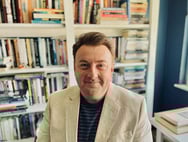
Dylan Hoffman聽studied liberal arts at Georgetown University and psychology at Adelphi University before completing his Ph.D. in Depth Psychology at 51社区鈥攃oncentrating in Jungian and Archetypal Studies. His work focuses on C. G. Jung鈥檚 theory of archetypes鈥攐n archetypes as the deepest nature of the psyche and how they interconnect spirit, psyche, and matter as numinous and mythic powers that animate, govern, and structure the cosmos as a whole. Dylan grounds his work in indigenous/shamanic perspectives and practices that provide a primordial, holistic, and sacred聽worldview within which to understand the archetypal psyche, to embody its wholeness individually, and to serve it culturally through creative imagination.
