

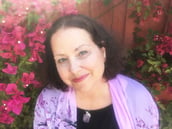
Romona Thomas is a student in the M.A./Ph.D. in Mythological Studies with Emphasis in Depth Psychology program, as well as a co-editor of The Between Journal, a creative arts journal featuring creative writing, poetry, art, performative art, and music created by Pacifica students. I鈥檓 delighted to speak with Romona about the journal and her experience at Pacifica.
Angela Wood: Thank you for speaking with me today. You鈥檝e had an entire career before you came to Pacifica, having been an educator for 33 years, and also having worked as a substance abuse counselor and social worker. What led you to Pacifica and why Mythological Studies, in particular?
Romona Thomas: My original life plan was to obtain a doctorate by age 35, but instead I had a child. When my son was young, we would spend Saturdays at Barnes and Noble or Borders. My mother introduced me to myth, and I, in turn, passed that love of myth to my son. Two years ago, he spent three months in Greece interning as a social worker. He paid my way to Greece. We spent two weeks touring all the places that I had only read about. Asklepios鈥檚 temple at Epidaurus where people would lie in an abaton, a room, and Asklepios would send them healing dreams while they slept. Asklepios is considered the first doctor. His staff had one snake wrapped around it as an indication that he used snakes in his healing rituals. Standing in the temple ruins, I felt awe, and the healing presence of Asklepios. In Greece, the modern architecture and subway sit next to ancient temples. It鈥檚 a juxtaposition of the new and old. It鈥檚 not a surprise that Asklepios and healing figure largely in my dissertation.
I love myth. I鈥檓 a mythie! My first master鈥檚 is in school counseling, so psychology is something that I am also very interested in. At 57, I was an empty nester, looking for my next quest. When I found this program, and this was the only one that combined mythology, depth psychology, religion, literature, and research in the United States, I knew.
Angela: What impact has the program and studying myth had on you?
Romona: It has transformed me in ways that I never expected. I see life in the world differently, especially in these mythic times. Jung鈥檚 archetypes and Hillman鈥檚 archetypal images live within and through many people. Being able to see people through this type of mythic lens helps me to act with empathy, compassion, and hopefully more understanding of others. Through myth and Dream Tending my own dreams and nightmares, my life and outlook have changed tremendously.
 Angela: The Between Journal is in its 25th year, this year the theme being 鈥淭ending the World鈥檚 Soul: One Story at a Time.鈥� As a mythologist, how can story tend soul?
Romona: Christine Downing, a professor at Pacifica for many years would start out with 鈥淢yth is story.鈥� The stories we tell ourselves impact how we live in the world. Myth and stories speak to soul because they鈥檙e metaphors. Christine would also say, 鈥淢yths are stories that never were but always are,鈥� meaning that the purpose of myth is to help us make connection in the world we鈥檙e in and see with a different lens. And re-story or re-myth, if necessary. In my dissertation, I鈥檓 working with the embodied Medusa. There鈥檚 a statue in NYC that is a replica of Luciano Garbati鈥檚 statue Medusa with Perseus鈥檚 Head, inverting the story, instead of Perseus slaying her. Garbati鈥檚 statue inspired me to write a new telling of the story鈥攁 re-mything. The story speaks to women because Medusa was a victim of rape, and then she was revictimized by being exiled with her hair turned to snakes. As part of today鈥檚 patriarchal culture, women are still punished when they鈥檙e the victims. In the 70s Medusa became the voice of feminist rage. Fifty years later, she thrives. She is a woman with agency, no longer re-acting, but acting upon the world. To have an embodied Medusa gives women hope that we will, eventually, be treated as equals. She gives women a 鈥渟he-ro,鈥� someone to look up to and emulate, to say 鈥淚 can act upon the world, I don鈥檛 have to be a re-actor.鈥� That鈥檚 what myth does. We鈥檙e changing the old patriarchal stories, and creating new myths, new ways of being and doing in the world.
Angela: What kind of material did you put together for this issue, and what was the process like?
Romona: It took several years. We started in 2022. We accepted a lot of stories, not just from myth, but from all other programs, as a celebration of healing, tending the world鈥檚 soul. There鈥檚 poetry and prose, some fairy tales. Some are personal stories. I just ask, 鈥淒oes this feel like a story that belongs? Does it have the capacity to tend and heal the world鈥檚 soul?鈥�
Angela: You鈥檙e working on your dissertation right now, 鈥淗ealing Through Nightmares, Play, and the Imaginal: The Dark Night of the Mind, Body, and Soul.鈥� I assume that Dream Tending and active imagination are part of this? How did the topic come together and what form is it taking?

Romona: It took me a year and a half to figure out the topic of my dissertation. I thought I was going to work with just dreams, my own dreams with Greek myth.聽 Then I was going to work with Native American mythology, because I live on Mojave land. But that didn鈥檛 come together. I鈥檇 read Robert Romanyshyn鈥檚 Wounded Researcher and he talks about the topic coming to you rather than you finding the topic. It appears. I was walking my dog when I realized the three dreams I鈥檇 chosen to tend and write about were nightmares. It made more sense to work with them as nightmares. As far as the healing part, besides tending dreams, I do a lot of active imagination work with them, talking with the 鈥渋ntolerable images鈥� as Stepen Aizenstat terms the horrific nightmare figures. And I do something called SoulCollage(R). I collage my dreams and work with them through the cards with active imagination, through the images. It鈥檚 a Jungian arts-based research project, so the research and writing will culminates in a memoir with the three nightmares in it. The title of this memoir is Medusa and Me: Awakening from the Nightmares of My Life.
Angela: Do you find that in working with dreams that your dreams take on a different quality? In as much as your unconscious is where dreams come from, does it realize that you鈥檙e listening, paying attention, and give you richer or different dreams?
Romona: That鈥檚 an interesting question. I鈥檇 never thought about that. They do. One of the things you do in dream tending is you use a Hillmanian perspective of 鈥渟eeing through鈥� the layers of the images; leading to a multiplicity of meanings. I see dreaming and dream tending as an expansion of the dream rather than a reduction to the meanings of individual images. You can go back into the dream and follow the image. For instance, there鈥檚 a snake in your dream. Not only are you going to have a conversation with the animal and you鈥檒l ask the purpose of the visit and what concept or archetype is visiting. It does lend a different quality to dreaming, in the sense that there are times when I know I鈥檓 in a nightmare, so I tolerate the images in order to what message psyche has for me. Nightmares are psyche鈥檚 way of saying, 鈥淲ake up. Pay attention. This is important and you鈥檙e not listening.鈥�
Angela: What advice would you give people who have completed their first career and are thinking about coming to Pacifica, but feel a little apprehensive about taking on a degree program?
Romona: You鈥檙e never too old to learn! Chris Downing, Professor Emeritus, retired five years ago at age 90. When I started the program, I was 57, and I鈥檒l be 65 when I graduate. I kept seeing things on TV and in magazines that were talking about regret that people express as they are dying. It wasn鈥檛 the things that they did, but the opportunities that they did not take. And so, when I started thinking about getting a doctorate, I asked, 鈥淲hat do I want to experience that I haven鈥檛 done yet?鈥� I wanted to do it for me. Just because we鈥檙e older doesn鈥檛 mean we need to give up on our dreams. As an older woman, I bring a different perspective to the work and the discussions. In the first half of life, we focus on the external, such as careers, what others think. After 50 years of age, Jung says that our perspective shifts dramatically toward the inner journey of spirituality, understanding and accepting or changing who we are to who we are becoming. Through these last seven years, I have begun to realize that the next chapter of my life is just beginning. There鈥檚 more to do, to see, and to learn. Life is far from over.
Angela: Thank you so much for speaking with me and for your work on The Between Journal. I look forward to seeing your dissertation in its complete form!
The Between Journal is available here.
For those interested in the M.A./Ph.D. in Mythological Studies with Emphasis in Depth Psychology program, visit us here.
***Header art is “Commitment” by Romona Thomas.

Romona Thomas is a retired educator with 33 years of teaching special education, elementary general education, and school counseling, who has worked as a substance abuse counselor and a social worker in two men’s prisons, owned a bookstore, and taught on the Hopi and Navajo reservations. Romona is also a Deathwalker, Life Celebrant, SoulCollage(R) facilitator and practitioner, and Dream Tender, with creative writing in three of the Between journals, and one article in the Mythological Studies Journal. Romona also presented a ten-minute play that she wrote at the 2024 Mythologem Conference hosted by the International Society of Mythology (ISM). In the world beyond the myth program, Romona belongs to a group called SIS (Sisters in Success) that promotes networking with other women and their businesses. Romona has presented SoulCollage(R) and partnered with a long-time educator and expert in professional learning to provide problem-solving experiences as a way to collaborate and access each woman’s strengths in a safe environment to facilitate a more collaborative networking system
Angela Wood聽is a writer for 51社区, as well as the editor of the聽Santa Barbara Literary Journal.聽Her work has been published in聽Food & 51社区, Peregrine, Hurricanes & Swan Songs, Delirium Corridor, Still Arts Quarterly, Danse Macabre,聽and is forthcoming in聽The Tertiary Lodger听补苍诲听Running Wild Anthology of Stories, Vol. 5.
